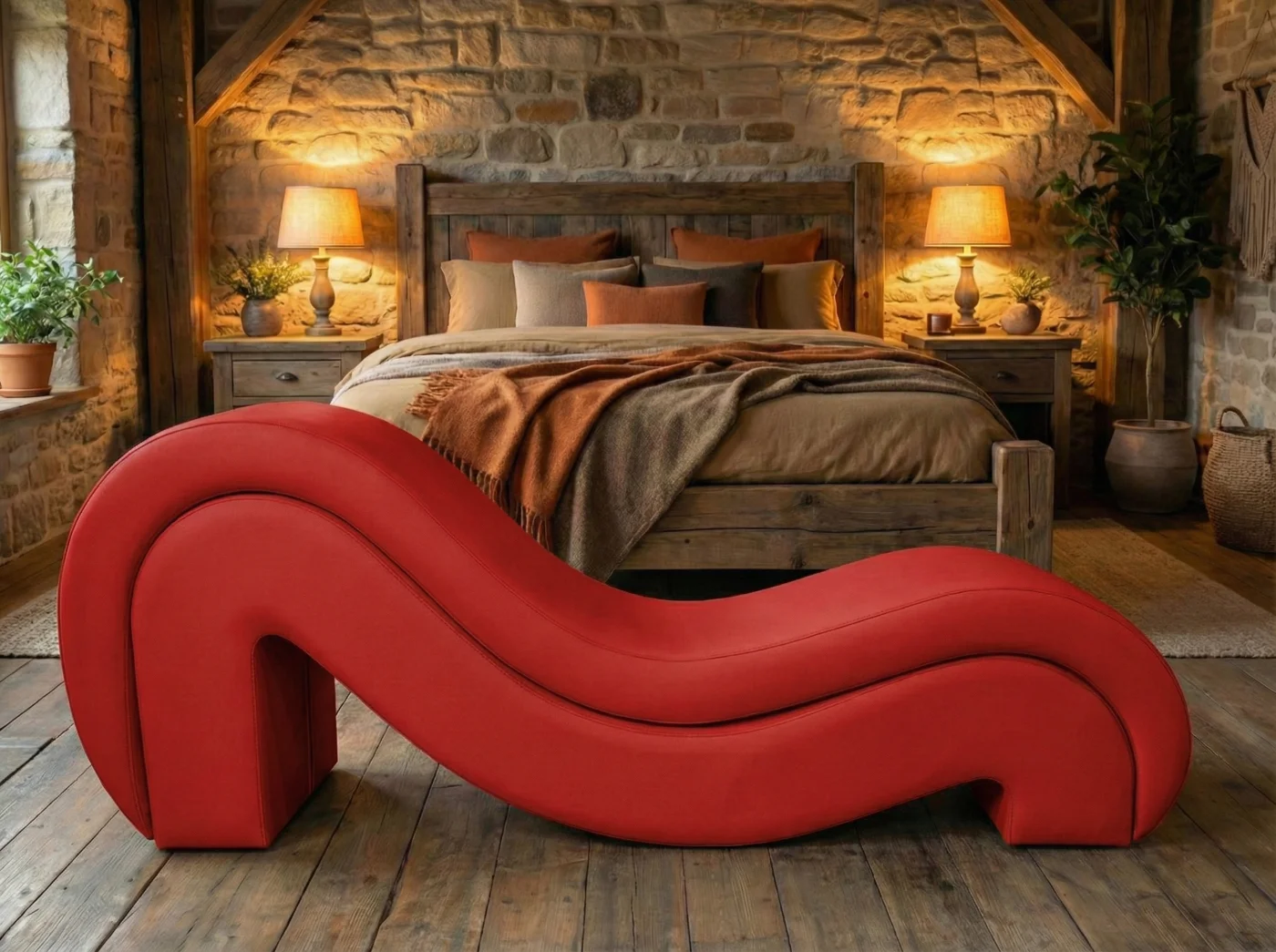
The quality behind our Tantra Chairs
A historical origin linked to comfort and discretion
The history of ergonomic furniture designed for intimacy is by no means recent. Its earliest documented predecessor dates back to 1880, when an exclusive chair was created for King Edward VII of the United Kingdom. That piece was designed to enhance comfort and relaxation during intimate encounters without requiring physical effort. Over the decades, that concept evolved into today’s Tantra Chair: a piece of furniture with organic lines that blends naturally into bedroom or living room decor.
Today, the aesthetic of a Tantra Chair allows it to function as an elegant chaise longue in full view of anyone. However, its value lies not only in its silhouette, but in the internal engineering that guarantees comfort, stability, and long-lasting durability.
Structure, density, and materials
Internal frame: the solidity of treated wood
The frame is the decisive element ensuring that a piece of furniture of this nature withstands the test of time and continuous movement. Unlike low-quality replicas made from particle board or frameless moulded foams, our genuine Tantra Chair is built on a frame of treated, reinforced timber.
Master carpenters cut each slat with fraction-of-an-inch precision to assemble a firm framework. This traditional joinery ensures that the piece does not yield, creak, or lose stability under heavy loads or intense friction. The strength of the frame guarantees that the Tantra Chair will keep its shape intact through years of continuous use.
Foam density: firmness, ergonomics, and durability
Behind the curves of our Tantra Chair is no ordinary conventional padding.
The foam used dictates how the body anatomically responds when resting on it and its ability to recover volume.
Low-density foams deform quickly, creating uncomfortable dips in areas of high pressure. By contrast, our Tantra Chairs use high-density, high-resilience polyurethane. This material provides the perfect balance between postural firmness and softness to the touch. It withstands concentrated pressure at specific points without giving way and immediately recovers its original geometry when weight is removed, preventing permanent deformation.
High-durability upholstery and easy cleaning
The outer covering must satisfy two fundamental requirements: mechanical resistance to friction and maximum ease of hygienic maintenance. Therefore, the choice of fabric for a Tantra Chair adheres to strict functional criteria.
In the premium faux leather option, the non-porous material prevents the absorption of liquids or fluids. Cleaning takes seconds using a damp cloth with neutral soap. Additionally, these finishes often feature antibacterial and antifungal treatments, such as Permablok3® protection, ensuring a completely hygienic environment. Its resistance to abrasion exceeds the most demanding Martindale rubbing tests, preventing the surface from cracking or peeling with intensive use.
For those who prefer textile finishes, there are stain-resistant fabrics with liquid-repellent technology and an ultra-soft feel, as well as heavyweight, flame-retardant decorative upholsteries. In all cases, the fabric is cut using automated systems to achieve a flawless fit over the curves of the Tantra Chair, finished with double-reinforced stitching using specialized machinery.
Handcrafted manufacturing and bespoke customisation
Every space is different, and every user seeks a specific finish that complements their room’s colour palette. The handcrafted manufacturing of the Tantra Chair allows every detail to be customized to the customer’s taste.
With over two hundred colour and texture options, you can choose between neutral tones that blend the piece in with the rest of the furniture or vibrant shades that make it the focal point. Dimensions can even be adapted for interior design or hospitality projects.
This bespoke production ensures that each Chair is a unique piece, made in the UK with rigorous quality controls.